
Introduction: The Role of Cylinder Liners in Diesel Engines
Cylinder liners form the inner walls of the combustion chamber in diesel engines, such as the Cummins ISX. These liners protect the engine block from direct wear, assist in heat transfer, and help maintain optimal compression ratios. Over time, technological advancements and emissions regulations have pushed manufacturers to develop different liner types, each with specific performance and maintenance benefits.
In the Cummins ISX platform, liner variations play a critical role in:
-
Heat dissipation
-
Oil control
-
Combustion efficiency
-
Carbon deposit reduction
-
Durability and longevity
Why Cylinder Liner Progression Matters
If you’re rebuilding or repairing a Cummins ISX engine, installing the wrong liner type can result in catastrophic engine damage or performance inefficiencies. Each liner type in the ISX family is tailored to a specific engine architecture, piston design, and emissions setup.
Understanding this progression is essential for:
-
Mechanics doing overhauls
-
Fleets managing engine rebuilds
-
Parts suppliers ensuring proper inventory
-
Remanufacturers maintaining EPA compliance

Cummins ISX Liner Evolution Overview
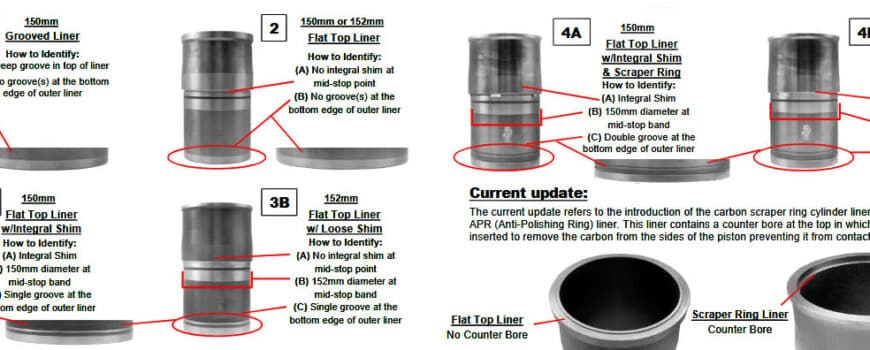
Cummins ISX liners evolved through five major stages:
| Type | Diameter | Shim | Scraper Ring | Groove Position |
|---|---|---|---|---|
| 1 | 150mm | No | No | Top only |
| 2 | 150/152mm | No | No | None |
| 3A | 150mm | Integral | No | Bottom (1) |
| 3B | 152mm | Loose | No | Bottom (1) |
| 4A | 150mm | Integral | Yes | Bottom (2) |
| 4B | 152mm | Loose | Yes | Bottom (2) |
Type 1: 150mm Grooved Liner
Key Features:
-
Deep groove at the top edge of the liner
-
150mm diameter
-
No grooves at the bottom
-
No shim (integral or loose)
Use Case:
Commonly found in older ISX engines manufactured before 2003. Ideal for non-EGR applications or legacy rebuilds.
Drawbacks:
-
Prone to carbon buildup at the top due to absence of scraper mechanism
-
Limited availability due to outdated design
Type 2: 150mm or 152mm Flat Top Liner
This design eliminated the top groove entirely for easier piston engagement and liner seating.
150mm Variant:
-
No shim
-
No groove at bottom
-
Used in early-mid EGR engines
152mm Variant:
-
Slightly wider mid-stop diameter
-
Better thermal tolerance
Installation Tip: Never interchange 150mm and 152mm liners without piston and head measurements.
Type 3A: 150mm Flat Top with Integral Shim
How to Identify:
-
Shim is cast into the liner wall
-
Single groove at the bottom
-
Accurate piston height without added shims
Benefits:
-
Reduced installation error
-
Stronger combustion sealing
-
Common in post-2004 ISX engines
Type 3B: 152mm Flat Top with Loose Shim
Unique Trait:
Loose shim (often copper or steel) placed manually during liner installation.
Cautions:
-
Shim must match piston and block specifications
-
Improper shim placement = combustion leaks
Best For:
Applications requiring height adjustments or when piston protrusion is already borderline.
Type 4A: 150mm Flat Top with Integral Shim & Scraper Ring
Also Called: APR Liner or Anti-Polishing Ring Liner
Key Characteristics:
-
Integral shim
-
Scraper ring embedded at top (counter bore)
-
Dual grooves at bottom
Advantage:
Removes carbon from piston crown as it moves upward—reduces polishing of liner walls.
Type 4B: 152mm Flat Top with Loose Shim & Scraper Ring
This is the most advanced design for Cummins ISX as of 2025.
Key Features:
-
Counter bore at top for scraper ring
-
Double bottom groove
-
152mm mid-band
-
Loose shim configuration
Voice Search Prompt:
“How can I tell if my Cummins ISX liner has a scraper ring?”
What Is a Scraper Ring (Anti-Polishing Ring)?
A Scraper Ring, also known as an Anti-Polishing Ring (APR), is a stainless or hardened steel insert mounted at the top of the liner, within a machined counter bore.
Function:
It scrapes carbon deposits from the piston’s upper area to:
-
Prevent bore glazing
-
Enhance oil control
-
Reduce emissions
-
Extend piston and ring lifespan
Scraper Ring vs. Non-Scraper Ring: Technical Impact
| Feature | Non-APR Liner | APR Liner (Scraper Ring) |
|---|---|---|
| Oil Control | Lower | Higher |
| Carbon Buildup | Likely | Reduced |
| Emission Readiness | Poor | Better |
| Wear Rate | Higher | Lower |
| Liner Longevity | Average | Extended |
150mm vs. 152mm Liners – Crucial Differences
150mm liners have a smaller outer diameter at the mid-stop band and are generally older models.
152mm liners are newer and used in engines requiring greater wall thickness for emissions and durability.
Warning:
Never interchange without piston & block compatibility check!
Liner Groove Positions: What Do They Mean?
-
Top Groove: Seen only in grooved liners. Now obsolete.
-
Single Groove at Bottom: Found in 3A and 3B.
-
Double Groove at Bottom: 4A and 4B liners.
Grooves aid in liner seating and act as ID markers during inspection.
What Is a Counter Bore and Why Does It Matter?
The counter bore is a machined pocket at the top of the liner to house the scraper ring.
Without it, no scraper ring can be installed.
Voice Search Tip:
“What does a counter bore do in a diesel cylinder liner?”
How to Identify Your ISX Liner in Under 2 Minutes
-
Measure mid-stop diameter (150mm or 152mm)
-
Check for shim at mid-band
-
Look for groove(s) at bottom
-
Check for counter bore at top
-
Note liner part number and cross-reference
Upgrading to APR Liners: Is It Worth It?
Yes—if you’re doing a full overhaul or emission rebuild, switching to Scraper Ring Liners improves:
-
Oil consumption
-
Piston wear
-
Liner service intervals
At HeavyDutyKits.com, we stock upgrade-compatible kits that include the correct pistons, liners, and rings.
Common Installation Mistakes
-
Installing 150mm liners in 152mm blocks
-
Forgetting loose shim
-
Using scraper ring liner without correct piston
-
Not measuring liner height or piston protrusion
-
Mixing liner types within one engine
Heavy Duty Kits: Your ISX Liner Experts
At HeavyDutyKits.com, we support diesel rebuilders with:
-
Precision Matched Kits: Pistons, liners, scraper rings
-
OEM-Grade Materials
-
Fast Shipping & technical support
-
Educational resources for builders and fleet managers
Whether you’re sourcing a Type 4B liner with scraper ring or matching an older grooved liner for a legacy block, our team ensures you’re always installing the correct part.
FAQs
Q: How do I know if my Cummins ISX liner has a scraper ring?
A: Look for a machined counter bore at the top of the liner. Scraper ring liners also have two bottom grooves.
Q: Can I use a 150mm liner in a 152mm engine block?
A: No. The diameters are not interchangeable and can cause piston slap or blow-by.
Q: What does an integral shim do?
A: It controls piston height, preventing the need for external adjustments.
Q: How do scraper rings prevent bore polishing?
A: They remove carbon deposits before the piston crown touches the liner wall.
Q: Can I upgrade my older ISX to scraper ring liners?
A: Yes, but you’ll need compatible pistons and liners designed for the APR setup.
Final Thoughts: Choose Smart, Rebuild Right
Cylinder liner selection isn’t just about size—it’s about matching your engine’s architecture, performance goals, and longevity requirements. With the variety available in Cummins ISX liners, including the revolutionary scraper ring designs, you can build smarter, run longer, and comply with today’s strictest standards.
Let HeavyDutyKits.com be your technical partner in that journey.